
For every post on Lemmy, I will create a conlang on it to show that I am active on that social media site. I developed for myself a conlanging package for myself that I perfected over the years, in which I have many sources to back up my ethos. I want to start off with the protolanguage before proceeding to the conlang itself.
I don’t know what to call the language, so for now it will be known by its codename Melym. Basically, it is an SOV agglutinative language, with verbal infix vowel morphological shift and has a simple glottal system of only one glottal consonant.
The major influences on the Melym language include from most important to least important:
- Dida
- Palauan
- Central Teke
- Big Nambas and Northeastern Malakula
- Basque
- Zhuang
- Inuktitut
- Muria
- Armenian
- Bunjevac (Serbo-Croatian)
Consonants
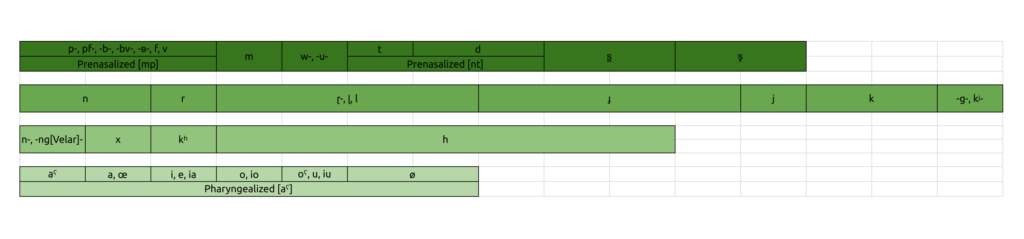
Northern Malakula language is among the few languages on Earth that use the bilabial trill phoneme. As such, it finds itself in Melym. Also, just like the Bantu languages Dida and Central Teke, and Northeast Malakula, it also uses prenasalized labial clusters. Like Basque, it differentiates between voiceless alveolar fricative [s̻] and voiceless alveolar retracted sibilant [s̺]. It also relies on voiced palatal plosive [ɟ] from Inuktitut and palatalized voiceless velar plosive [kʲ] from Zhuang. I also relied on Muria phonology for the retroflex consonants [ɽ] and [ɭ]. While it does have a simple glottal system with only a single voiceless glottal fricative [h], it still relies on Armenian and Bunjevac, a Serbo-Croatian dialect, for the voiceless velar fricative [x] and the voiced velar nasal [ng] appearing before a velar consonant.
Vowels
Because the first five languages provide the most amount of inspiration for Melym, I decided that since vowels are the most important, irreplaceable parts of the phonology, they are inspired by those languages. I borrow the pharyngealized vowels from Dida, the diphthongs from Palau, and the open-mid front unrounded vowel [œ] and close mid-front unrounded vowel [ø] from Northeast Malakula.
While the languages Palauan, Dida, and Zhuang deal with tone, I want to focus on tone later in the series.
Gateway Sources
- Brave Browser
- Wikipedia
Primary Sources
- Charette, Monik (1984). “Analyse phonologique des emprunts en dida de Niakassé”. Revue québécoise de linguistique (in French). 14 (1). Montreal: University of Quebec: 87–111. doi:10.7202/602529ar.
- de Rijk, Rudolf P. G. (2008). Standard Basque: a progressive grammar. Cambridge, MA: MIT Press.
- Duhamel, Marie (2010). The Noun Phrase of Atchin: A language of Malakula Vanuatu (PDF). University of Auckland.
- Dum-Tragut, Jasmine (2009). Armenian: Modern Eastern Armenian. London Oriental and African language library. Amsterdam: John Benjamins Publishing Company.
- Flora, Jo-Ann (1974), Palauan Phonology and Morphology, PhD Dissertation: University of California, San Diego.
- Kaye, Jonathan; Charette, Monik (December 1981). “Tone sensitive rules in Dida”. Cahiers ivoiriens de recherche linguistique. 9 (8): 82–85.
- Lynch, John (2020). The Phonological History of Uripiv, an Eastern Malakula Language. Language & Linguistics in Melanesia 38. pp. 10–37.
- Mallon, Mick. “Introductory Inuktitut.” Arctic College-McGill University Inuktitut Text Project. 1991.
- “Introductory Inuktitut Reference Grammar.” Arctic College-McGill University Inuktitut Text Project. 1991.
- “Inuktitut Linguistics for Technocrats”. Inuktitutcomputing.ca.
- Masson, Denis (1992). “Esquisse phonologique du dida de Yocoboué”. In Egner, Ingeborg (ed.). Esquisses phonologiques de trois langues ivoriennes: beng, dida, yaouré. Abidjan & Paris: Inst. de Linguistique Appliquée (ILA); Agence de Coopération Culturelle et Technique (ACCT). pp. 1–56.
- Matthew, Thomas; Matthew, Rincy (2013). “Far Western Muria (Gaita Koitor Boli) Phonology Summary” (PDF). sil.org. SIL International. Archived (PDF) from the original on 2015-05-12.
- Miller, Kirk (2005). The Tones of Abou Dida (MA thesis). Santa Barbara: University of California.
- Morén, Bruce (August 2006). “Consonant-Vowel Interactions in Serbian: Features, Representations and Constraint Interactions” (PDF). Lingua. 116 (8): 1198–1244.
- Omniglot.
- “Central Teke (Tɛgɛ).”
- “Yocoboué Dida (Dída).”
- “Zhuang (Vahcuengh / Vaƅcueŋƅ / 話僮).”
- Zuraw, Kie (2003), “Vowel Reduction in Palauan Reduplicants” (PDF), in Andrea Rackowski; Norvin Richards (eds.), Proceedings of the Eighth Annual Meeting of the Austronesian Formal Linguistics Association, Cambridge: MITWPL #44, pp. 385–398.